

Knowing what makes a car’s engine run smooth keeps your ride in top shape. When the engine works like a finely tuned clock, spotting problems early feels easy, and fixing them won’t break the bank. Swapping oil or scrubbing spark plugs can keep the engine running way past what most expect. Imagine saving loads of cash and skipping major headaches by trying these simple tricks. Drivers who spend lots of time on the road will find this info super valuable. Keep reading—some secret tips are coming that will make the car feel fresh off the showroom floor.
Talking about the parts of a car’s engine is crucial to identify the correct use of your vehicle. By knowing how the engine works, you will be able to be cautious and take into account some details that extend the car’s useful life.
We always want you to move safely and one of the best ways is to know how the parts of your vehicle work. That is why today we will focus on the parts of a car’s engine.
Although the performance of the diesel engine and the gasoline engine is different, it is understood that the two types can be identified as internal combustion engines, therefore, the engine parts are very similar.
Remember that in the automotive market there are also other types of engines, such as electric and hybrid. However, in this case, we will deal with the internal combustion engine because it is still the most popular in the market.
What is an internal combustion engine?
To define the parts of a car engine we must begin by defining what an internal combustion engine is. At first, we establish that the engine is the heart of the vehicle, it is one of its most important parts since it is here that the force and speed with which the car will move is determined. Each part of the engine provides energy and allows the engine to move.
Along the same lines, we find that an internal combustion engine is one that obtains mechanical energy from the chemical energy produced by diesel or gasoline together with air. Although it is the most polluting type of engine, in relation to the hybrid and electric, it is still the most popular in the market.
Parts of a car engine
As mentioned above, the parts of a gasoline car engine are similar to those of a diesel engine. However, you should keep in mind that both have different characteristics that are evident in their performance and power.
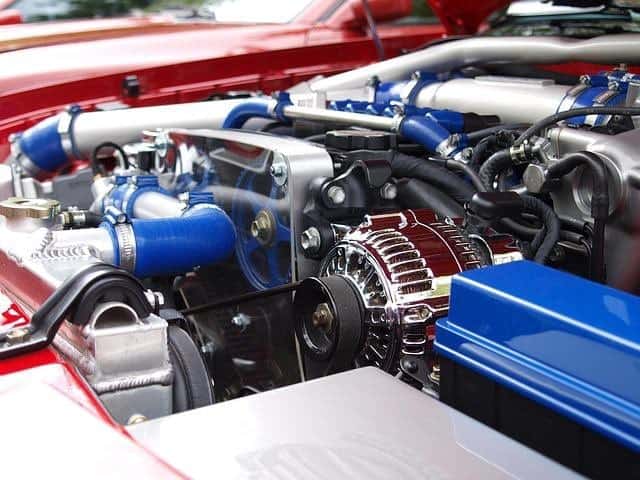
Generally, the engine is located at the front of the vehicle and it is distinguished because it is a large piece of metal, but keep in mind that its size varies from one vehicle to another. The following is a description of the parts of a car engine:
The block and cylinders: We hear a lot about the displacement of a vehicle. We could consider these, which are located inside the block, as the main part of the engine. The cylinders reflect the potential of the car, as well as its gasoline consumption. It is in these cylinders that the transformation of the fuel into the mechanical force necessary for the vehicle to move takes place. Cylinders can be from 2 to 16. The complements of the cylinders are the water, cooling, and lubrication oil lines.
Pistons and crankshaft: this is where the difference between a gasoline and a diesel engine becomes evident. Combustion is generated differently:
Gasoline engine: The explosion of the fuel-air mixture is generated by the spark plug, this moves the pistons that rise and fall inside the cylinders and drive the crankshaft. The pistons and the crankshaft are in charge of converting the combustion energy into mechanical energy that moves the wheels of your car.
Diesel engine: In the case of this type of engine, the explosion that allows the movement of the vehicle occurs automatically when the diesel mixture reaches a very high temperature, approximately 300°C (300°F).
As part of this system and linked to the pistons are other elements. First, there is the connecting rod, which is defined as the arm that supports the movement of the pistons. On the other hand, there is the crankshaft, which is the counterweight crank that produces a circular effect of the connecting rod and the piston, facilitating its repetition, similar to the movement of the pedals of a bicycle.
Cylinder heads: called the upper layer of the cylinders. This is where some parts of the vehicle’s engine are located, such as the air and gasoline intake valves and the exhaust valves. These valves are controlled by the camshaft, as a timer. Also, you can find the spark plugs, which are responsible for mixing the fuel and air by means of a spark.
Crankcase: it is a kind of tray located at the bottom of the engine, in charge of storing the oil used to lubricate the engine parts.
How does the engine work?
After talking about the parts of a car engine, we will begin to explain how it works, pay attention!
Remember that in this case, we are talking about an internal combustion engine, different from the operation of a hybrid or electric engine. The combustion engine cycle consists of four strokes:
Intake: in this phase of the cycle the valve introduces air and gasoline into the cylinder, which causes the piston to move down. In the case of a diesel engine, only the air is introduced, as the diesel will enter the next stage.
Compression: in this part of the process the piston moves up and compresses the air-fuel mixture.
Combustion: because the mixture was compressed, it produces an explosion. In the case of gasoline vehicles, this is caused by the spark from the spark plug, and in the case of diesel vehicles, it is caused by the high temperatures reached by the engine. Due to the explosion or power stroke, the piston drops.
Exhaust: the last moment of this process occurs when the piston rises again and the exhaust valve opens to expel the gas produced by the explosion.